Rahu and Ketu: The Shadow Planets Driving Your Deepest Desires
Rahu and Ketu aren't planets — they're mathematical points, but they pack a punch. Learn how these shadowy nodes reveal your obsessions, your karmic baggage, and what you're here to master in this lifetime.
You've probably heard someone blame "bad Rahu" for their internet addiction or credit "Ketu's detachment" for their sudden decision to move to a monastery. But here's the thing: Rahu and Ketu aren't planets at all. They're the north and south lunar nodes — points where the Moon's orbit crosses the ecliptic. In Vedic astrology, they're called Chhaya Grahas, shadow planets. And they're responsible for the stuff that keeps you up at night: your cravings, your fears, your secret talents you never quite claim.
Rahu is the head of the demon. Ketu is the body, severed from the head. The myth goes that during the churning of the ocean, a demon named Swarbhanu snuck a sip of the nectar of immortality. The Sun and Moon ratted him out, and Vishnu sliced him in half. But by then, the nectar had already touched his lips. So both halves became immortal — and forever hungry. Rahu — the head — chases the Sun and Moon, causing eclipses. Ketu — the tail — floats off, severed and strange.
That myth is your life. Rahu is what you chase, what you crave, what you'll never have enough of. Ketu is what you've already mastered, what you're weirdly good at but might feel bored by. Together, they point to your dharma — and your undoing.
Rahu: The Head of the Dragon — Obsession, Desire, and the World's Glitter
Rahu shows up in your birth chart as a point of intense desire. It's not subtle. Think of it as a cosmic spotlight on the area of life where you feel incomplete — and you'll try anything to fill that void. Rahu in the 10th house? You might obsess over career, fame, being seen. Rahu in the 7th? You're drawn to partners who are foreign, unconventional, or completely wrong for you on paper. In the 11th house, it's money, networks, social climbing.
Classical texts like Brihat Parashara Hora Shastra (Chapter 3, verse 10) describe Rahu as "equal to Saturn" in its malefic nature — but there's a catch: Rahu loves material success. It's a natural politician, a strategist. It can give you wealth, status, and the ability to bend rules. But the price? You never feel satisfied. That's the nectar and the poison.
Here's what makes Rahu tricky: it amplifies whatever it touches. If it aspects your Mercury, you might become a brilliant communicator — or a compulsive liar. If it aspects your Venus, you could be a seducer, an artist, or someone who ruins relationships chasing a fantasy. The key is to check which sign and house Rahu sits in, and which planet rules that sign. That planet becomes your "Rahu trigger" — the area where you'll overdo it.
Rahu doesn't care about ethics. It cares about intensity. It's the part of you that stays up all night scrolling, that says "one more drink," that marries the wrong person because the chase was thrilling.
Ketu: The Tail of the Dragon — Detachment, Wisdom, and the Things You've Left Behind
Ketu is the opposite pole. Where Rahu is craving, Ketu is letting go. Ketu in the 1st house? You might feel like you don't belong in your own skin. Ketu in the 5th house? You're naturally creative, but you don't care about applause. Ketu in the 9th? You could have deep spiritual insights but no interest in organized religion.
Ketu represents past-life mastery. The skills you came into this life already knowing — and therefore bored of. Ever met someone who's a natural artist but won't pick up a brush? That's Ketu. Someone who's brilliant at business but chooses poverty? That's Ketu. But Ketu also gives a kind of wisdom that can't be taught. It's the eye of the needle. The ability to see through illusions.
Phaladeepika (Chapter 23, verse 8) calls Ketu "crooked, wind-natured, and a giver of emancipation." Emancipation — because once you've mastered something, you're free from needing it. But Ketu's shadow side is dissociation. Too much Ketu influence can make you feel like a ghost in your own life. You might struggle to connect, to commit, to care.
Ketu's lesson: stop clinging. It's the node that says "you already have everything you need" — even when it doesn't feel that way.
The Axis of Destiny: How Rahu and Ketu Work Together
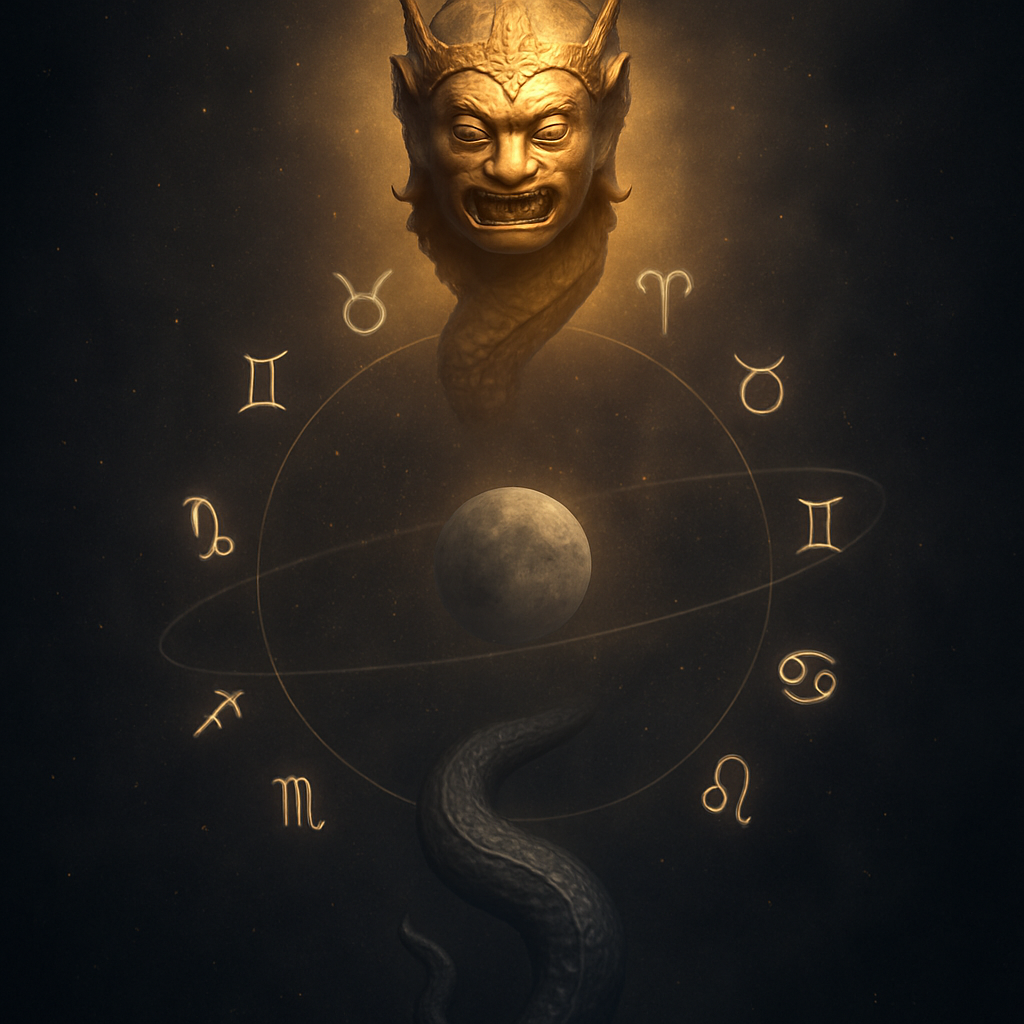
Your Rahu and Ketu are always exactly 180 degrees apart, forming an axis that spans two opposite houses in your chart. That axis is your karmic tightrope. Rahu points to what you're supposed to develop in this life. Ketu points to what you've overdeveloped in past lives — and need to release.
Let me give you a real example: Steve Jobs had Rahu in the 1st house in Sagittarius, Ketu in the 7th in Gemini. Rahu in the 1st — obsessive about his image, his vision, his personal brand. He chased perfection relentlessly. Ketu in the 7th — detachment from partnerships, messy relationships, difficulty compromising. He mastered innovation (Ketu in Gemini) but had to learn to balance that with collaboration (Rahu's lesson in the 1st is to lead, but not alone).
Another one: Mahatma Gandhi had Rahu in the 10th house in Libra, Ketu in the 4th in Aries. Rahu in the 10th — a consuming drive for public life and social reform. Ketu in the 4th — detachment from home, family legacy, and emotional security. He gave up domestic comfort for the nation. That's the axis: you sacrifice one area to build another.
Practical takeaway: Look at your own chart. The houses where Rahu and Ketu sit are the two arenas where your life will feel most fated. You'll feel pulled toward Rahu's house — but you'll also feel a strange competence or emptiness in Ketu's house. The goal isn't to abandon Ketu; it's to integrate both.
Transits and Dashas: When the Nodes Wake Up
Rahu and Ketu move slowly — about 18 months per sign. Their transits can stir things up. When Rahu transits over a planet or house in your chart, that area becomes amplified. You might get obsessed, feel restless, or attract dramatic events. Ketu's transit tends to bring endings, withdrawals, or sudden moments of clarity.
But the real power of the nodes shows up in the Vimshottari dasha system. Each planet rules a period of your life — Rahu's dasha lasts 18 years, Ketu's 7. During a Rahu dasha, you'll experience the themes of that house on steroids. You might chase a goal relentlessly, make or lose a fortune, or go through a major identity shift. Ketu dasha can feel like spiritual bootcamp — isolation, loss, but also deep insight.
I've seen people become unrecognizable during Rahu dasha. A quiet accountant starts a rock band. A monk falls in love and leaves the monastery. The node doesn't care about your plans. It cares about your evolution.
Working with the Shadow: A Practical Guide
So what do you actually do with this information? Three things:
- Identify your Rahu trigger planet. The lord of the sign where Rahu sits will tell you what you're prone to overdoing. If Rahu is in Virgo, Mercury-ruled, you might obsess over details, health, or criticism. Channel that into precision work — but watch for paralysis.
- Honor Ketu's gifts. That thing you dismiss as easy? Someone else is struggling with it. If Ketu gives you a natural talent, use it. Not for ego — but as service. That's how you purify Ketu.
- Balance the axis. Don't neglect Ketu's house while chasing Rahu. If Rahu is in your career house (10th), you need to also nurture your home life (4th). The nodes are a seesaw — if you only sit on one side, you'll fall.
Classical remedies include feeding crows on Saturdays (for Ketu) or donating blue clothes (for Rahu), but honestly? The best remedy is awareness. When you feel that Rahu-like hunger rising, pause. Ask: "Will this fulfill me, or just distract me?" And when Ketu makes you want to run away, ask: "Am I detaching from what's healthy, or from what's holding me back?"
Your Next Step: See Your Own Nodes
I've been reading charts for over fifteen years, and I still see people surprised by their Rahu-Ketu axis. It explains so much. The impossible standards you set. The things you're weirdly good at but don't value. The patterns in your relationships that feel almost scripted.
If you want to understand the shadow planets driving your deepest desires, get your free birth chart reading on AstroClick. We'll map your Rahu and Ketu — and show you exactly where your soul is trying to grow. It's free, it's detailed, and it might just change how you see your whole life.
And honestly? That's what the nodes are for.
Cover image: A cinematic close-up of a golden serpent head with a glowing pearl, coiling around a cracked hourglass, set against a midnight blue sky with faint stars. Inline images: IMAGE1: A brass Sri Yantra on burgundy silk under warm candlelight. IMAGE2: An ethereal white lotus with smoky grey tendrils rising from its center. IMAGE_3: A vertical axis illustration of Rahu (head) and Ketu (tail) with zodiac signs and lunar orbit.