Mercury Retrograde Survival Guide: Why It's Not What You Think

Mercury retrograde isn't cosmic sabotage. It's actually a precision instrument for revision, and once you know how it really works, you'll stop dreading it.
The Panic You've Been Sold
Every time Mercury stations retrograde, the internet explodes. Don't sign contracts. Don't buy electronics. Don't text your ex. Mercury's going backward (it's not, but we'll get to that), so naturally your entire life is about to implode.
Here's the thing: I've watched fifteen years of Mercury retrogrades come and go. I've signed leases during them. Launched websites. Had some of the most clarifying conversations of my life. And I'm still here, laptop intact, relationships mostly functional. The popular narrative around Mercury retrograde is about 30% accurate and 70% marketing-driven anxiety. What if I told you that this three-week cycle, which happens three or four times a year, is actually one of astrology's most useful tools for getting your life back on track?
Let me show you what's really happening when Mercury appears to reverse course, why ancient astrologers didn't lose their minds over it, and how to work with the retrograde instead of white-knuckling your way through it.

What's Actually Happening Up There
Mercury doesn't go backward. That's the first myth to crush. What we call retrograde motion is an optical illusion created by the difference in orbital speeds between Earth and Mercury. Picture two cars on a highway: when you pass the slower car, it looks like it's moving backward relative to you. Same principle.
From our perspective here on Earth, Mercury appears to slow down, stop (that's the station), reverse direction for about three weeks, stop again, and resume normal forward motion. Astronomically, it's just Mercury doing its regular lap around the Sun, moving faster than Earth on the inner track.
But here's where it gets interesting. In Vedic astrology (Jyotish), retrograde planets are called vakri. They're considered to be intensified, turned inward, operating on a different wavelength. Not broken. Not malicious. Just… refocused. Western astrology largely agrees: a retrograde planet brings its significations back to you for review.
Mercury rules communication, commerce, travel, contracts, technology, siblings, short trips, and the analytical mind. When it stations retrograde, all of those domains get the "re-" prefix attached. Re-think. Re-visit. Re-negotiate. Re-connect. It's a built-in cosmic edit button, and if you're a writer, a therapist, an accountant, or anyone who works with information, you already know how valuable revision is.
The problem is that we live in a culture allergic to slowdowns. Mercury retrograde forces a pause, and we interpret the pause as a problem.
The Shadow Periods Nobody Talks About
Most people mark their calendars for the retrograde itself. But the real action starts earlier.
About two weeks before Mercury stations retrograde, it crosses the degree where it will eventually station direct. This is called the shadow zone or pre-retrograde shadow. Then Mercury retrogrades back over all that territory. Then it stations direct and covers the same ground a third time during the post-retrograde shadow.
So if Mercury stations retrograde at 15° Aries and goes back to 5° Aries before stationing direct, you're going to experience the themes of 5°–15° Aries three times. That's roughly six to eight weeks of the same material cycling through your chart.
Let me give you a real example. In August 2023, Mercury stationed retrograde at 21° Virgo and went back to 8° Virgo. If you have planets or angles between 8° and 21° Virgo (or Gemini, Pisces, or Sagittarius, since those are the other mutable signs), you felt that retrograde as a repeating loop. First introduction to the theme. Then the backward review. Then the final integration.
This is why Mercury retrograde often brings people, problems, or projects from the past back into your life. You're literally retracing your steps. The universe is asking: did you get it right the first time? Is there something you missed? Do you need to say it again, differently?
Ancient texts like the Brihat Parashara Hora Shastra (Chapter 27) note that retrograde planets give results related to past karma. It's not punishment. It's pattern recognition.
What Mercury Retrograde Is Actually Good For
This is where most survival guides get it wrong. They give you a list of prohibitions. Don't do this, avoid that, brace for impact. But Mercury retrograde isn't a dead zone. It's a specific kind of productivity.
Here's what I've found works beautifully during Mercury Rx:
- Editing and revision. This is prime time for going back through a manuscript, refining a pitch, debugging code you wrote two months ago. The retrograde mind catches what the forward mind missed.
- Reconnecting with old contacts. That collaborator you lost touch with? The client who went quiet? Retrogrades are for rekindling. I've seen more successful "hey, it's been a while" emails during Rx periods than at any other time.
- Research, especially historical or archival work. You're digging backward through information. That's Mercury retrograde's home turf.
- Therapy and introspection. Retrograde Mercury turns the analytical mind inward. You'll notice patterns in your own thinking you've been too busy to catch.
- Renegotiating contracts or revisiting terms. Notice the "re-" prefix. If you're already in a negotiation and it stalls out, that's often a gift. Details you missed will surface.
I finished the first draft of my book proposal during a Mercury retrograde in Gemini. I didn't start it then (I'm not reckless). But the process of refining the structure, cutting what didn't work, tightening the argument? Perfect retrograde work.

The "Don't" List (And Why It's Conditional)
Yes, there are things that tend to go sideways during Mercury retrograde. But context is everything.
Signing contracts: The standard advice is don't. But if you're signing a renewal or re-negotiating an existing deal, that's actually on-theme. The issue is launching something brand new without having reviewed it. I once signed a lease during Mercury Rx after going back to look at the apartment a second time and catching a plumbing issue I'd missed. The retrograde saved me.
Buying electronics: There's some statistical truth to this one. Mercury rules technology, and when it's retrograde, things slip through quality control. But if you're buying refurbished gear or replacing something that broke, you're fine. Again, it's the "re-" theme.
Major launches: Starting a business, a website, a campaign during Rx can mean you'll have to redo parts of it. That said, if you've been planning it for months and the launch date just happens to fall during Rx, don't panic. Build in extra buffer time and have a revision plan ready.
Travel: Delays are more common. I always pad my layovers during Rx and download offline maps. But I also had one of the most unexpectedly meaningful trips of my life during a Mercury retrograde in Sagittarius because a cancelled connecting flight put me in a city I'd lived in a decade earlier. I reconnected with two old friends I'd lost track of. Retrograde serendipity.
The real guideline is this: if it's new and you're rushing it, wait. If it's a return, a review, or a revision, you're golden.
How to Track It in Your Own Chart
This is where the rubber meets the road. Generic Mercury retrograde advice is like a weather report for the entire planet. Useful in a vague way, but not personalized.
You need to know:
- Which house Mercury is retrograding through in your natal chart. That tells you the life area getting the review. Mercury Rx in your 7th house? Relationships and partnerships are up for re-evaluation. In your 10th? Career and public roles. In your 2nd? Money, values, resources.
- Whether Mercury is retrograding over any of your natal planets. If you have Venus at 12° Virgo and Mercury retrogrades from 15° Virgo back to 8° Virgo, it's going to cross your Venus three times. Conversations about love, money, creativity, or aesthetics will loop. You'll be asked to reconsider, refine, re-articulate.
- What Mercury rules in your chart. If you're a Gemini or Virgo rising, Mercury is your chart ruler. Retrogrades will feel more personal, more like your entire operating system is getting a software update. If Mercury rules your 7th house, retrogrades will consistently bring relationship themes.
Let's say you're a Scorpio rising. Mercury rules your 8th house (Gemini) and 11th house (Virgo). When Mercury goes retrograde, you might revisit shared finances, dig into psychological material you thought you'd processed, or reconnect with old friends and communities. You're not just "dealing with Mercury retrograde" in some generic sense. You're re-examining intimacy and group belonging.
A quick example from a client's chart: Aquarius rising, Mercury ruling the 5th and 8th houses. During a Mercury retrograde in Leo (her 7th house), an ex-partner reached out (7th house relationships), they had long conversations about creative projects they'd abandoned together (5th house), and she realized she'd been avoiding vulnerability (8th house). By the time Mercury stationed direct, she'd ended a different relationship that had been limping along. The retrograde clarified what the forward motion had obscured.
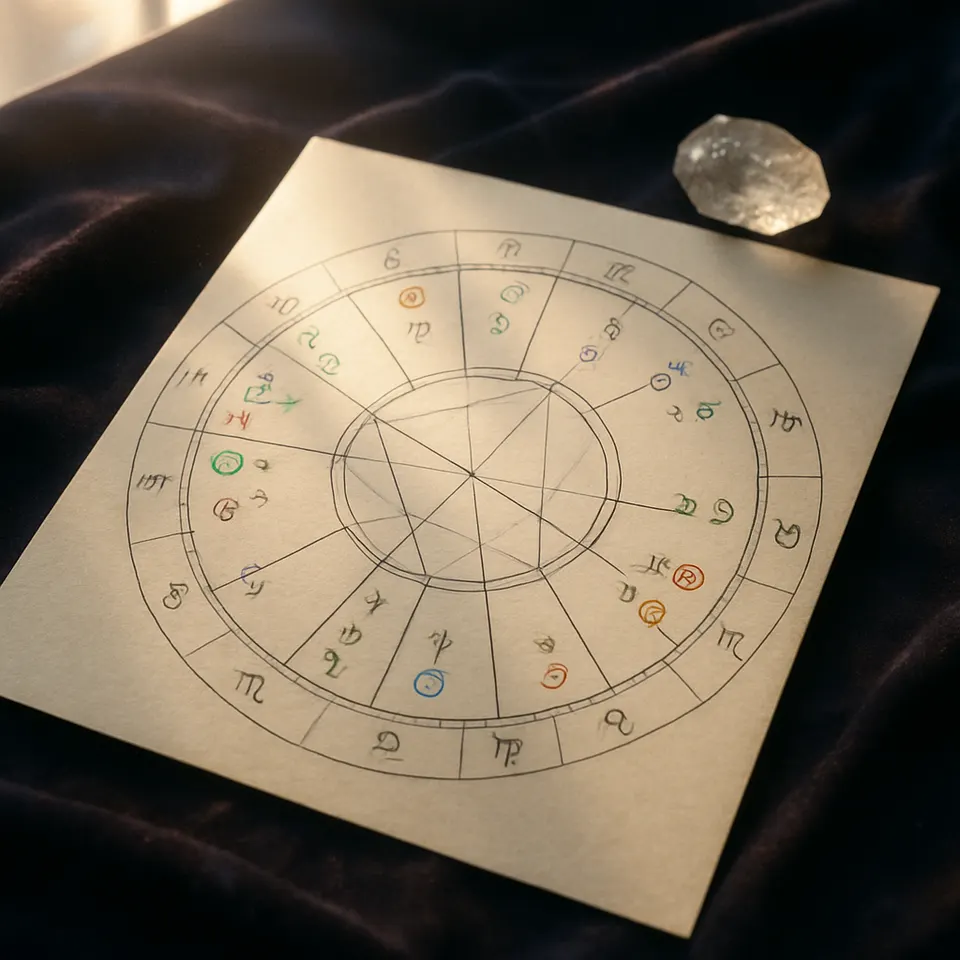
The Myth of Mercury Retrograde as Cosmic Sabotage
Here's what bothers me most about mainstream Mercury retrograde panic: it teaches people to be passive victims of the sky. It frames astrology as fatalistic, something that happens to you, rather than a language that helps you time your decisions and understand your internal cycles.
Mercury retrograde is not out to get you. It's not a punishment. It's a rhythm.
In Vedic astrology, we talk about kala (time) as having qualities. Some times are sharp and fast, good for initiation. Other times are reflective and slow, good for consolidation. Mercury retrograde is the latter. If you try to use it like the former, you'll get friction. That's not the retrograde's fault. That's a mismatch between tool and task.
I think the reason Mercury Rx gets such a bad rap is that it reveals our lack of preparation. If your systems are fragile, a retrograde will expose that. If your communication has been sloppy, the retrograde will surface the misunderstandings. If you've been ignoring a persistent problem, it'll come back around.
But that's incredibly useful information. Mercury retrograde is diagnostic. It shows you where the weak points are so you can reinforce them.
Working the Retrograde Like a Pro
Here's my personal Mercury retrograde protocol, developed over years of trial and error:
One week before the retrograde:
- Back up your devices. All of them.
- Confirm travel plans and double-check times.
- If you're in the middle of a negotiation, try to finalize it before the station or be prepared for it to stretch into the retrograde period (and accept that new information will surface).
During the retrograde:
- Keep a revision list. This is not the time to plow forward. It's the time to catch what you missed. I keep a running doc of "things to fix/revisit" and actually enjoy working through it.
- Reach out to people you've lost touch with. I send at least three "Hey, I was thinking about you" messages during every Rx. The response rate is weirdly high.
- Re-read, re-watch, re-listen. I revisit books, films, albums I loved years ago. I always catch something new.
- Expect delays and miscommunications, but don't catastrophize them. Assume you'll need to clarify, repeat, or reschedule. Build that buffer in.
Post-retrograde shadow:
- This is integration time. Mercury is direct, but it's still covering the same degrees it just retrograded over. Finalize the edits. Send the revised version. Lock in the new terms. This is when forward momentum returns, but it's informed forward momentum.
If you want to get advanced, track your personal Mercury retrograde themes over time. I keep a simple spreadsheet: date, sign, house in my chart, major events or insights. After a few years, patterns emerge. You'll notice that Mercury Rx in fire signs feels different from Rx in earth signs. You'll see that certain houses in your chart are more sensitive to the retrograde than others.
Why You'll Actually Miss It When It's Gone
I'll say something controversial: I like Mercury retrograde.
Not in a performative, "I'm so enlightened" way. I mean it practically. Three or four times a year, I get cosmically sanctioned permission to slow down, revisit my work, and clean up loose ends without feeling like I'm falling behind. The retrograde takes the guilt out of revision.
And honestly? Some of my best ideas have come during Mercury Rx. Because I'm not in "produce new content" mode, I'm in "what did I miss?" mode, and that's where depth lives. I'll reread a chapter I wrote, spot a structural problem, and realize the solution has been sitting there the whole time. I'll have a conversation with someone I worked with two years ago, and a collaboration I'd written off suddenly makes sense again.
The retrograde gives you a second look. Sometimes a third. In a world that prioritizes speed over accuracy, that's a gift.
Your Next Mercury Retrograde Game Plan
So here's what I want you to do. Find out when the next Mercury retrograde is (AstroClick's tools will show you exact dates and degrees). Look up which house it's transiting in your chart. Check whether it's crossing any of your natal planets.
Then ask yourself: what have I been rushing through? What conversation did I leave unfinished? What project could use another pass? What old contact might be worth reconnecting with?
Don't brace for disaster. Plan for revision.
Mercury retrograde isn't cosmic sabotage. It's a precision instrument for going back and getting it right. And once you stop fighting it, you'll realize it's been working for you all along.
If you want to see exactly how the current or upcoming Mercury retrograde is hitting your chart (which houses, which planets, what themes to expect), grab your free personalized astrological reading over at AstroClick. Plug in your birth info and you'll get a detailed breakdown of how this cycle is showing up in your life specifically. Because generic advice is fine, but your chart is yours. And it's time to work with it, not against it.