The Life Line, Heart Line, Head Line: A Beginner's Guide to Palmistry
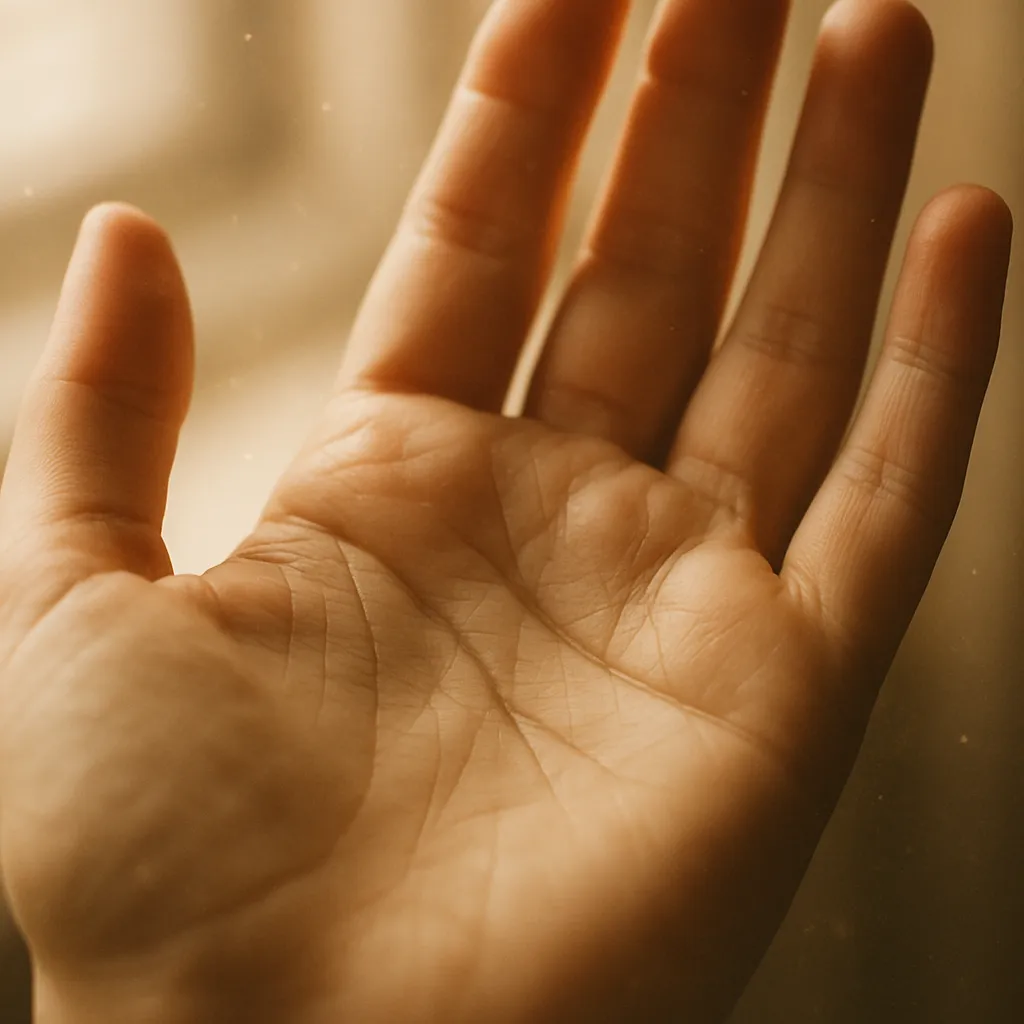
Forget fortune-telling parlors. Your palm contains a lifetime of patterns about how you think, love, and navigate energy. Here's how to read the three major lines.
The Map Already in Your Hand
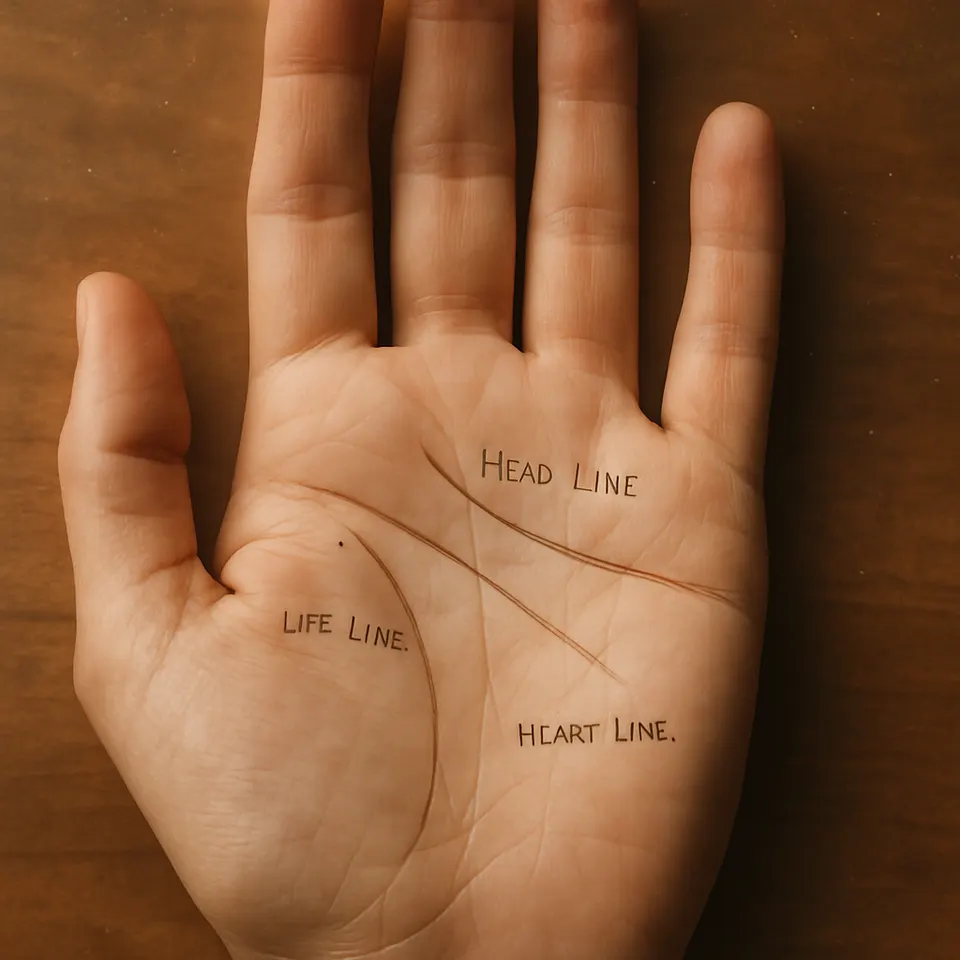
Hold your dominant hand up to the light. Those three deep creases curving across your palm? They've been there since you were in the womb, flexing tiny fists at sixteen weeks. The life line arcing around your thumb. The heart line running beneath your fingers. The head line cutting straight across the middle. Palmistry calls them the major lines, and they're not mystical stamps from the cosmos. They're neuromuscular signatures, marks left by how your hand folds, how you grip, how you've used this tool for decades. But here's the thing: those physical patterns correlate with psychological ones. Your hand really does tell a story.
I'm not talking about "you'll meet a tall stranger" nonsense. Proper palmistry, the kind practiced in India for three thousand years and catalogued in texts like the Hasta Samudrika Shastra, reads the hand the way a geologist reads strata. It's pattern recognition. And once you know what to look for, you can't unsee it.
!An open palm under soft natural window light showing the three major lines clearly visible
The Life Line: Not About Death (I Promise)
Let's kill the biggest myth first. The life line does not predict how long you'll live. It never did. That urban legend has terrified people with short life lines for generations, and it's complete rubbish.
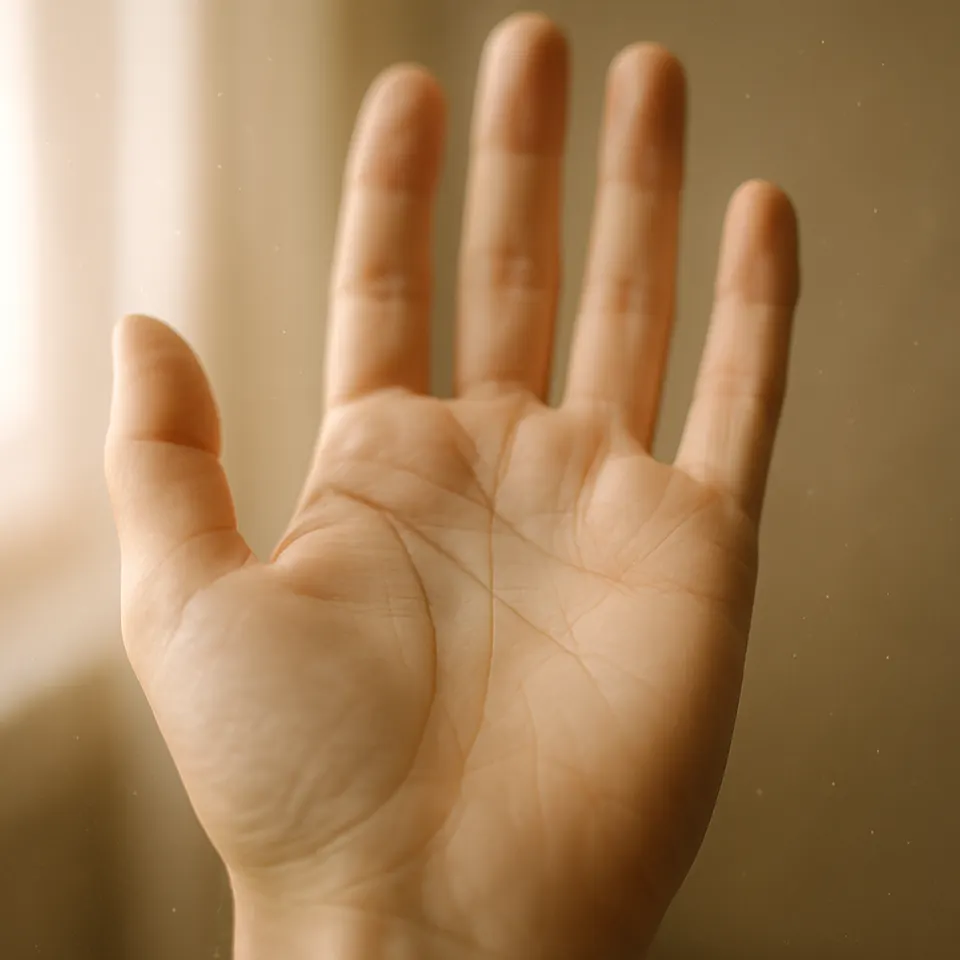
The life line arcs from the edge of your palm between thumb and index finger, swooping down around the fleshy mound at the base of your thumb (called the Mount of Venus in palmistry). What it actually shows is your vitality, your physical energy reserves, and how you relate to your body and the material world.
A deep, clear life line suggests robust stamina. You recover quickly from illness. You probably don't get knocked flat by a head cold the way some people do. If it sweeps in a wide arc, giving lots of real estate to that Venus mound, you've got warmth, generosity, a love of sensory pleasure. Food tastes better to you. Music hits harder.
A narrow life line, hugging close to the thumb? You're more cautious with your energy. You might tire easily, or you've learned to be strategic about where you spend your reserves. Neither is better. They're just different operating systems.
Here's where it gets specific:
- Breaks or islands in the line: These often correlate with periods of illness, surgery, or major life disruptions. I've seen this again and again. A woman showed me her palm once, and there was a clear island right at age 34 (you measure age by dividing the line into sections, starting at the top). She'd had a serious car accident that year. Coincidence? Maybe. But I've seen enough of these to pause.
- Chains or faint sections: Low energy during that period. Burnout. Chronic stress.
- A fork at the end: You'll likely spend later years traveling or living somewhere far from where you were born.
One more thing. The life line changes. I've compared hand prints from the same person ten years apart, and lines deepen, fade, even shift slightly. Your life isn't carved in stone. It's carved in flesh, and flesh is always rewriting itself.
The Heart Line: How You Love (and What Scares You)
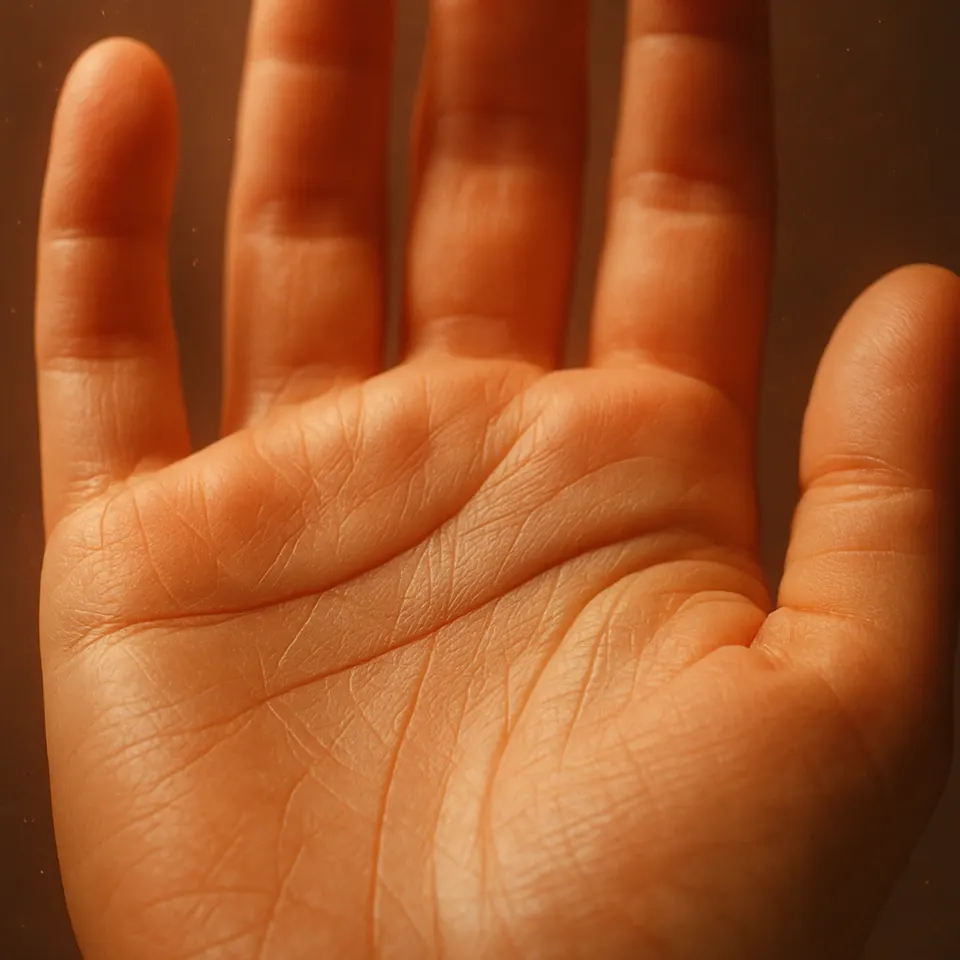
The heart line runs horizontally across the top of your palm, just below your fingers. It starts at the edge under your pinkie and curves toward your index or middle finger. This is the line everyone wants to know about, because we're all desperate to understand why we love the way we do.
In traditional palmistry, the heart line governs emotional expression, romantic patterns, and how you form attachments. But it's more textured than "you're passionate" or "you're reserved." The details matter.
If your heart line ends between your index and middle fingers, you've got balance. You're affectionate but not smothering. You can merge with a partner without losing yourself. If it curves up and ends directly under your index finger, you're an idealist in love. You want the fairy tale. You're probably also more vulnerable to disappointment when people turn out to be human.
A straight heart line, one that doesn't curve much at all? You're more guarded emotionally. You lead with your head in relationships. You need a lot of trust before you let someone in, and even then, you keep a corner of yourself private. There's nothing wrong with this. It just means you won't be the person crying on the second date.
Watch for these details:
- Deep and clear: Strong emotional health. You feel things fully and then they pass. You don't hold grudges for decades.
- Faint or fragmented: Emotional detachment, or a history of protecting yourself by numbing out. Sometimes both.
- Lots of little branches shooting upward: You're optimistic. You recover from heartbreak relatively quickly. Each branch is like a little reset button.
- Branches shooting downward: Disappointments in love. Each dip can mark a breakup, betrayal, or the slow death of something you thought would last.
I knew someone whose heart line had a dramatic fork, one branch shooting up to the index finger, the other veering down toward the head line. She told me she'd been engaged twice. First time, she called it off two weeks before the wedding because something felt off (the upward branch, intuition saving her). Second time, he left her for someone else (the downward branch, the wound). Both stories literally written in her hand.
!A close-up of fingers and upper palm showing the heart line in detail under warm overhead lighting
The Head Line: Your Operating System
The head line runs horizontally across the middle of your palm, usually starting near the life line (sometimes merged with it at the beginning) and extending toward the outer edge. This line shows how you think, process information, and make decisions.
A straight head line? You're logical, practical, literal. You want facts. You're probably good with numbers, systems, structure. You don't love ambiguity. A sloping head line, one that curves down toward the wrist? You're imaginative, intuitive, comfortable with abstract thinking. You're the person who sees patterns others miss, who makes creative leaps. Writers, artists, therapists tend to have sloping head lines.
Length matters too. A long head line stretching all the way across the palm indicates intellectual stamina. You can focus for hours. You enjoy complex problems. A shorter head line? You think quickly, make snap decisions, and you're usually right. You don't need to labor over every angle.
The space between the head line and the life line at the start is critical. If they're joined together for a bit before separating, you were cautious as a child. You needed approval. You thought twice before taking risks. If there's a gap between them right from the start? You were the kid who climbed too high, talked back, left home early. Independence was your religion.
Some specifics to look for:
- A forked ending (sometimes called a "writer's fork"): You can see both sides of an argument. You're versatile, adaptable, maybe a little indecisive.
- Islands or breaks: Periods of confusion, mental health struggles, or times when your thinking felt clouded. I had a student whose head line showed a faint island during her late twenties. She told me that's when she had a severe depressive episode. The line deepened again after.
- A head line that merges with the heart line: Extremely rare, but it means your emotions and logic are tangled. You can't separate what you feel from what you think. This can be beautiful or exhausting, depending on the day.
Here's something most palmistry guides won't tell you: the head line is the most stable of the three. It changes less over time than the heart or life lines, probably because your core cognitive style gets set relatively early. You might become wiser, but you won't suddenly switch from intuitive to hyper-rational.
Reading the Lines Together (Because Nothing Exists in Isolation)
You can't read one line and call it a day. The palm is a system. The way the lines interact, cross, or avoid each other tells the deeper story.
Look at where the life line and head line start. If they're tightly bound together for the first centimeter or so, your early environment shaped you deeply. You absorbed your family's fears, values, expectations. If they separate quickly, you differentiated early. You became your own person before age twenty, maybe before fifteen.
Now check where the heart line sits relative to the head line. A big gap between them? You keep emotion and logic in separate rooms. You're the person who can break up with someone and still analyze the relationship like a case study. If the lines are close together, nearly parallel? Your feelings influence every decision. You can't think your way out of what you feel.
I once read the palm of a man whose life line and head line were joined for nearly two inches before splitting. He'd lived at home until he was thirty-one, went to the college his parents chose, worked in the family business. When the lines finally separated on his palm, that's roughly when he quit the business and moved across the country. The timing matched within a year. This is what I mean when I say the hand is a map.
The Hand You Read (and Why It Matters)
In palmistry, you read the dominant hand for the life you're living now, the one you've built through choices and action. The non-dominant hand shows potential, what you were born with, the blueprint.
I'm right-handed, so my right palm shows the career I chose, the relationships I've nurtured, the consequences of staying up too late for twenty years. My left palm shows a slightly different heart line, a bit more optimistic. That's the version of me that didn't get hurt in a particular way. The me I might've been.
Some palmists read both hands and compare them to see where you've diverged from your natural path. Honestly, I find that a little fatalistic. I prefer to think of the non-dominant hand as your inheritance and the dominant as your edit. You're the author either way.
What Palmistry Won't Tell You (and What It Will)
Let's be clear about limitations. Palmistry can't predict lottery numbers, tell you if your crush likes you back, or give you next week's stock prices. Anyone who claims otherwise is running a con.
What it can do is reflect patterns. If your head line has been getting fainter over the last five years, and you've also been feeling creatively stuck or mentally foggy, that's correlation worth noticing. If your heart line shows a bunch of downward branches and you've got a history of picking emotionally unavailable partners, seeing it in your hand might help you interrupt the pattern.
Palmistry works best as a mirror. It shows you what's already there, helps you name it, and sometimes gives you permission to change course. The lines aren't orders. They're suggestions.
Learn Your Own Hand First
If you want to get good at this, start with your own palm. Spend a week just noticing it. Look at it in different light. Compare it to photos of your hand from five years ago if you have any. Notice which lines are deepest. See if you can connect the markings to events you lived through.
Then move on to someone you know well. A partner, sibling, close friend. Someone whose history you can verify. Read their major lines, make some observations, and ask if it resonates. You'll be surprised how often it does.
The best palmists I know aren't psychic. They're just very, very observant. They've looked at hundreds of hands, cross-referenced with hundreds of life stories, and learned to see the overlaps. You can do the same.
Why This Still Matters in 2025
We live in a world of genetic testing, brain scans, and personality algorithms. You can spit in a tube and get a report on your ancestry. You can take a quiz and be sorted into one of sixteen types. So why bother with palmistry, this ancient, analog art?
Because your hand is yours. It's been with you since before you had language. It's changed as you've changed. And unlike a DNA test or a Myers-Briggs result, you can see it whenever you want. You don't need a lab or a login.
There's something grounding about reading your own palm. It puts your history back in your hands—literally. It reminds you that your body keeps score, holds memory, shows evidence of every year you've been alive. In a culture that tries to abstract everything, palmistry is almost radically physical.
Plus, it's just interesting. Once you start seeing the patterns, you'll want to look at everyone's hands. On the train. At dinner. During meetings. (Try not to be creepy about it.)
Your Next Step
If this lit something up in you, if you looked at your palm halfway through reading this, you're already doing it right. Keep going. Get a small LED light and examine your lines up close. Take a photo. Compare your hands. Notice what you notice.
And if you want to go deeper, to see how the lines in your hand connect with the planets in your chart, the transits shaping your next year, the patterns you didn't even know were running the show? Get your free astrological reading at AstroClick. We'll map your entire chart, show you what's coming, and help you work with it instead of against it. Your hands hold part of the story. Your chart holds the rest. Let's read them together.