Diwali and the 5 Days of Lakshmi: Astrological Significance of Each Day
Each of Diwali's five days aligns with specific planetary energies and lunar phases. Here's what ancient astrology reveals about timing your rituals.
My grandmother used to light tiny clay lamps on the balcony for five nights straight, each night chanting different mantras, asking me to sit still and watch the flame. I didn't understand then that she was tracking something older than electricity or even the Julian calendar: she was following a five-act cosmic drama, each day ruled by different planetary forces, each designed to invoke a different facet of wealth, protection, and renewal.
Most people think Diwali is one night. It's not. It's a five-day festival that spans two lunar fortnights (pakshas), and the astrological architecture behind it is stunningly precise. The centerpiece is Lakshmi Puja on the new moon (Amavasya) in the Hindu month of Kartik, but the days before and after carry their own planetary signatures. Let's walk through them, one by one.
Day 1: Dhanteras (Trayodashi) – Venus, Mercury, and the Art of Acquisition
Dhanteras falls on the thirteenth lunar day (trayodashi) of Krishna Paksha, the waning moon phase. Astrologically, this is the domain of Kama (desire) and sensory discernment. The presiding deity is Dhanvantari, the celestial physician who emerged from the churning of the cosmic ocean carrying the nectar of immortality. But from a chart perspective, this day lights up Venus (Shukra) and Mercury (Budha).
Venus governs luxury, beauty, adornment, vehicles, and precious metals. Mercury rules commerce, wit, and discernment in transactions. Buying gold, silver, utensils, or new business assets on Dhanteras isn't superstition. It's timed planetary activation. When you purchase something of value on this day, you're anchoring Venus's significations into your second house (wealth, possessions) and eleventh house (gains) at a moment when the Moon is still strong enough to carry intention but humble enough not to eclipse it with ego.
Here's what matters practically:
- Purchase before sunset if possible. The Moon on trayodashi is still visible but thinning, symbolising letting go of old wealth patterns before the new moon reset.
- Avoid impulsive buys. Mercury wants shrewdness, not haste.
- If you're buying for business (a laptop, tools, a vehicle for work), do it on Dhanteras. If it's purely ornamental, wait for Day 3.
Traditional texts like the Brihat Samhita (Chapter 104) emphasise tithis (lunar days) over solar dates for auspicious transactions. Dhanteras is as much about mental preparation (clearing financial fear) as it is about acquisition.
Day 2: Naraka Chaturdashi (Choti Diwali) – Mars, Ketu, and the Purge
Chaturdashi, the fourteenth lunar day, carries the warrior's blade. This is the day Krishna (or Kali, depending on regional tradition) slayed the demon Narakasura. Astrologically, it's ruled by Mars (Mangal) and has a shadowy Ketu overtone. Mars is action, courage, the severing of obstacles. Ketu is renunciation, past-life karma, and spiritual detox.
The ritual of an early-morning oil bath (abhyanga snana) isn't just hygiene. Oil corresponds to Saturn and Mars in Ayurvedic astrology, both heavy, grounding, extractive. Rubbing oil into the skin and then washing it off symbolises drawing out old malefic influences, especially those related to ancestors (pitru dosha), debt (sixth house), and hidden enemies (twelfth house).
This is the day to:
- Wake before sunrise. Mars is strongest at dawn.
- Use sesame oil if you can get it. Sesame is Saturn's plant, and applying it on a Mars-ruled day creates a controlled friction that "burns off" stagnant energy.
- Light lamps in the south direction (ruled by Yama, god of death and dharma) to honour lineage and release ancestral patterns.
I find most people skip this day or treat it as a warm-up. Don't. Naraka Chaturdashi is your best shot at clearing the sixth house (debts, illness, enmity) and the eighth house (chronic obstacles, fears) before Lakshmi arrives. You wouldn't invite a guest into a dusty house. Same principle.
One more thing: if you've been dealing with recurring Mars-related issues (accidents, surgeries, anger, property disputes), this is the day to do a small Mars remedy. A red cloth tied to a peepal tree. A handful of red lentils donated. Mars appreciates directness.
Day 3: Amavasya (Lakshmi Puja) – Moon, Sun, and the Zero Point
Now we reach the heart. Amavasya, the new moon, is the astronomical moment when Sun and Moon occupy the same degree in the same sign. In Kartik (usually late October or early November), this happens in Libra (Tula) or Scorpio (Vrishchika), depending on the year and ayanamsa.
Why worship Lakshmi on the darkest night? Because abundance isn't about visibility. It's about receptivity. The new moon represents the womb, the void, the zero-point from which all creation springs. The Moon governs the mind (manas). When the Moon is invisible, the ego-mind quiets. In that silence, Lakshmi (who is Venus magnified, cosmic rather than personal) can enter.
Libra is Venus's own sign, exalted and refined. Scorpio is Mars's domain but also the eighth house of the natural zodiac, representing transformation, hidden wealth, and inheritance. Both signs favour regeneration. The new moon in either creates a cosmic reset button for second-house (wealth) and eleventh-house (income) significations.
From the Brihat Parashara Hora Shastra (Chapter 2, Shloka 3-4), the Moon is described as the karaka (significator) of the mind, and its phases directly influence mental receptivity to divine grace. On Amavasya, when the Moon is utterly dark, the veil between material and subtle realms is thinnest.
Here's the ritual spine, astrologically decoded:
- Timing: Perform Lakshmi Puja during Pradosh Kaal (the 2.5 hours after sunset). The Sun has set (ego withdrawn), but night hasn't fully settled (tamas not dominant). This is the Sattvic twilight.
- Direction: Face north or east. North is ruled by Mercury and Kubera (the treasurer of the gods). East is the Sun's direction, the rising of fortune.
- Offerings: Rice (Moon), turmeric (Jupiter), lotus (Venus), coins (Mercury). Each offering activates a planet.
- Mantra count: 108 (or multiples). The number 108 is cosmically encoded: 1 (Sun) × 8 (Saturn, the structure holder) = cosmic law. Or 27 nakshatras × 4 padas each.
If your natal chart has a weak Moon (debilitated, combust, or afflicted), Amavasya Lakshmi Puja can partially remedy it. You're essentially asking the cosmic mother to stabilise your mind and emotions so wealth can flow without leaking through anxiety or poor decisions.
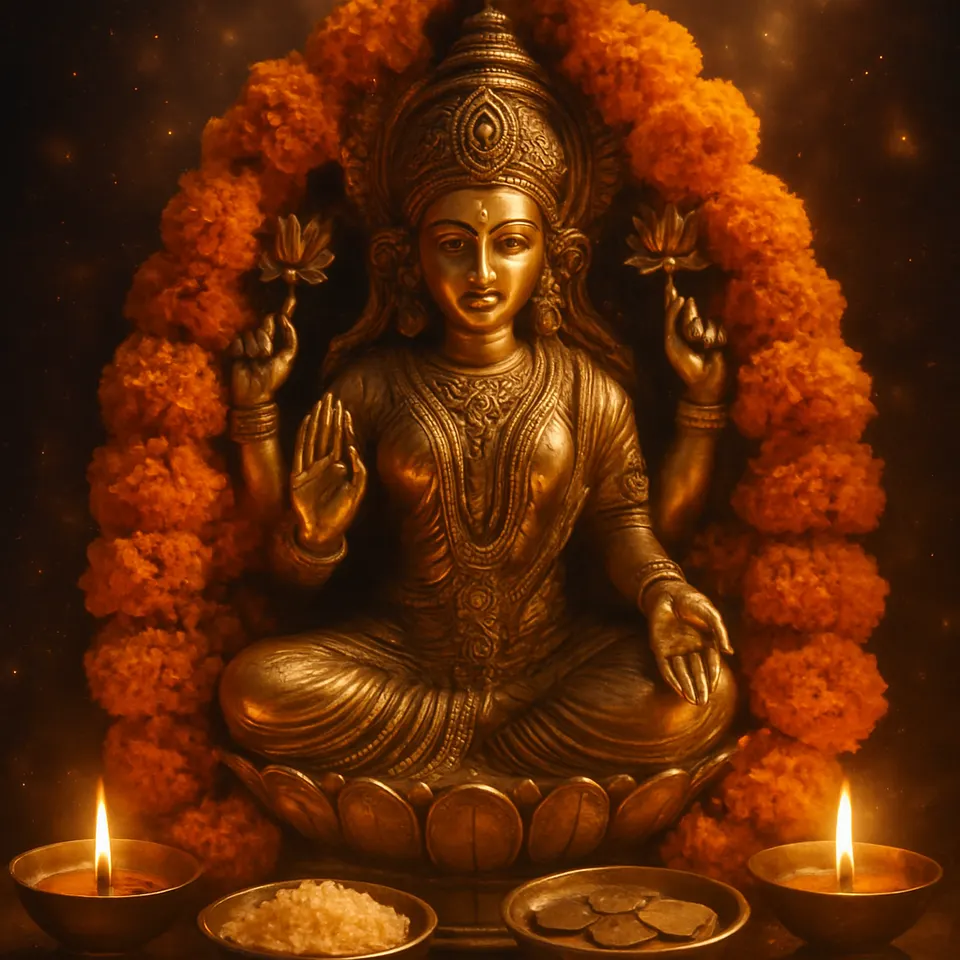
Day 4: Govardhan Puja (Pratipada) – Jupiter, Moon, and Nourishment Consciousness
Pratipada is the first day of the waxing moon (Shukla Paksha), and it belongs to Jupiter (Guru) and the Moon in her nurturing, motherly aspect. This is the day Krishna lifted Mount Govardhan to shelter the villagers from Indra's storm. Symbolically, it's about choosing dharma (Jupiter) over outdated power structures (Indra, who here represents ego-driven authority).
Astrologically, Govardhan Puja celebrates the first house (self, body, vitality) and the fourth house (home, nourishment, roots). After the void of Amavasya, the Moon begins to grow again. This is when you anchor new intentions into the body and the land.
The ritual of making a small hill from cow dung and decorating it with flowers might sound rustic, but it's a third-house and fourth-house activation. Cow dung is Saturn and Moon together: earth, fertility, the mothering principle. Building the mound with your hands (third house: skill, effort) and placing it in your home or courtyard (fourth house) quite literally grounds the blessings you invoked on Amavasya.
In North India, this day also marks Annakut, the offering of 56 or 108 different food items to Krishna. Food is Moon and Venus. Variety is Mercury. The act of offering is Jupiter (generosity, gratitude). By feeding the divine first, you're programming abundance consciousness into your fourth house (emotional security) and second house (food, resources).
Practical tips for this day:
- Cook something with your own hands, even if it's simple. Jupiter honours effort and sincerity.
- If you have a garden or even a potted plant, give it water and a pinch of turmeric. Fourth house activation.
- Donate food. Even a single meal to someone in need satisfies Jupiter's demand for generosity.
Jupiter transits slowly (about one sign per year). If Jupiter is moving through your second, fourth, fifth, ninth, or eleventh house this year, Govardhan Puja is your moment to lock in its blessings for the next twelve months.
Day 5: Bhai Dooj (Dwitiya) – Mars, Moon, and Sibling Bonds
Dwitiya, the second lunar day of Shukla Paksha, is ruled by Brahma in mythology, but astrologically it's Mars and Moon in conversation. This is the day Yama (god of death) visited his sister Yamuna, and she fed him, anointed his forehead, and received his blessing of protection. The relationship between brother and sister is a Mars-Moon dynamic: Mars protects, Moon nurtures.
In your natal chart, siblings are indicated by the third house. Mars is the natural karaka (significator) of siblings, especially younger brothers. The Moon represents sisters and the emotional bond. Bhai Dooj rituals activate and harmonise these two planets.
The tilak (vermillion mark) applied on the brother's forehead is a Mars remedy. Vermillion is red, Mars's colour. The forehead is the location of the Ajna chakra (third eye), ruled by Jupiter and the Moon. Applying it ritually is a miniature planetary exchange: the sister (Moon) blesses the brother's Mars with protection and foresight.
If you have a difficult third house (Mars afflicted, Rahu or Ketu placed there, or harsh aspects), Bhai Dooj is the day to repair it. Even if you don't have a biological sibling, you can honor a cousin, a close friend, or mentor as symbolic kin. The astrology works on intention and relationship, not just bloodline.
From the Phaladeepika (Chapter 17), the third house also governs courage, short journeys, and communication. Strengthening it through Bhai Dooj rituals can improve all those areas, not just sibling relationships.
What to do:
- If you're the sister, cook something sweet (Moon) and spicy (Mars) for your brother. The combination balances both planets.
- If you're the brother, give a gift that represents protection or support: a book (Mercury), a tool (Mars), money (Venus/Mercury).
- If you're estranged from siblings, light a lamp for reconciliation. Even if they never know, the third house softens.
Tying It All Together: The Panchanga in Motion
The five days of Diwali aren't random. They follow the structure of the Panchanga (the five-limb astrological calendar): tithi (lunar day), vara (weekday), nakshatra (lunar mansion), yoga (Sun-Moon angle), and karana (half-tithi). Each day is chosen not just for mythology but for maximum planetary resonance.
When you observe all five days, you're essentially running a complete astrological cycle:
- Dhanteras (Venus/Mercury): Activate second and eleventh houses (wealth, gains).
- Naraka Chaturdashi (Mars/Ketu): Clear sixth and eighth houses (obstacles, fear).
- Amavasya (Moon/Sun): Reset first, fourth, and ninth houses (self, home, fortune).
- Govardhan Puja (Jupiter/Moon): Strengthen fourth and fifth houses (nourishment, creativity).
- Bhai Dooj (Mars/Moon): Harmonise third house (siblings, courage).
You've just done a five-day planetary remedial cycle, integrated into cultural ritual so seamlessly that most people don't even realise they're doing astrology.
One thing I'll say from experience: you don't need to be Hindu, Indian, or even religious to work with this framework. The planets don't care about your passport or your belief system. They care about timing, intention, and sincerity. If you align your actions with these cosmic windows, you'll feel the difference. Not in a lightning-bolt way, but in the quiet way a house feels different after it's been cleaned.
What the Transits Tell Us This Year (and Every Year)
Every Diwali happens during a slightly different planetary weather pattern. Some years, Jupiter is exalted in Cancer, showering ease. Other years, Saturn is retrograde in Aquarius, asking for maturity and patience. The five-day structure remains the same, but the flavour shifts.
Before you start the festival, check:
- Where is the Moon transiting on Amavasya? That's the house in your chart getting the reset.
- Is Venus strong or weak? If Venus is combust or retrograde, Dhanteras purchases may not yield the satisfaction you expect. Adjust expectations.
- What's Mars doing? If Mars is debilitated or afflicted, Naraka Chaturdashi remedies become even more critical.
If you don't know how to read transits, that's fine. Just notice how you feel during each of the five days. Your body and mind are antennae. They pick up planetary shifts even when your intellect doesn't.
Your Move
If you've read this far, you're probably the kind of person who wants to go deeper. You don't just want to light a lamp because someone told you to. You want to know why, and you want it to mean something.
Here's my suggestion: pick just one of the five days this year and do it fully. Not all five half-heartedly. One, with attention. If you're dealing with financial stress, go all-in on Dhanteras. If you're weighed down by family karma or chronic health stuff, make Naraka Chaturdashi your anchor. If your mind is scattered and you can't seem to hold onto money, Amavasya is your day.
And if you want to understand what your own chart says about wealth, timing, and the houses we've talked about here, get your free astrological reading on AstroClick. You'll see exactly where Venus, Mars, Jupiter, and the Moon sit in your chart, and which of the five Diwali days will serve you most. Think of it as a personal roadmap for the festival, and honestly, for the year ahead.
Happy Diwali. May your lamps stay lit, and may the planets be kind.