7th House in Vedic Astrology: The House of Spouse and Partnerships
The 7th house reveals who you marry, how you love, and what you need in partnership. It's the mirror that shows you what you can't see in yourself.
The Mirror You Sleep Next To
Your 7th house doesn't just describe your future spouse. It shows you the qualities you project onto others, the traits you think you lack, and the parts of yourself you'll only discover through intimacy. It sits directly across from your 1st house (your rising sign, your selfhood), which means it's the astrological equivalent of holding up a mirror. What you see there? That's what you're unconsciously looking for in someone else.
In Vedic astrology, the 7th house is called Yuvati Bhava, the house of partnership, and it governs marriage, business partnerships, open enemies, and the public's perception of you. Classical texts like the Brihat Parashara Hora Shastra (chapters 15–16) spend considerable time on this house because, let's be honest, who you marry shapes your life more than almost any other single decision. Your 7th house lord, the planets sitting in your 7th, and the aspects landing there all paint a detailed portrait of your partner's nature, the timing of marriage, and how that relationship will unfold.
But here's the thing: the 7th house isn't fate carved in stone. It's a blueprint. You can meet someone who fits every astrological marker and still choose not to marry them. Or you can work with challenging placements and build something lasting. The chart shows the weather, not whether you'll carry an umbrella.
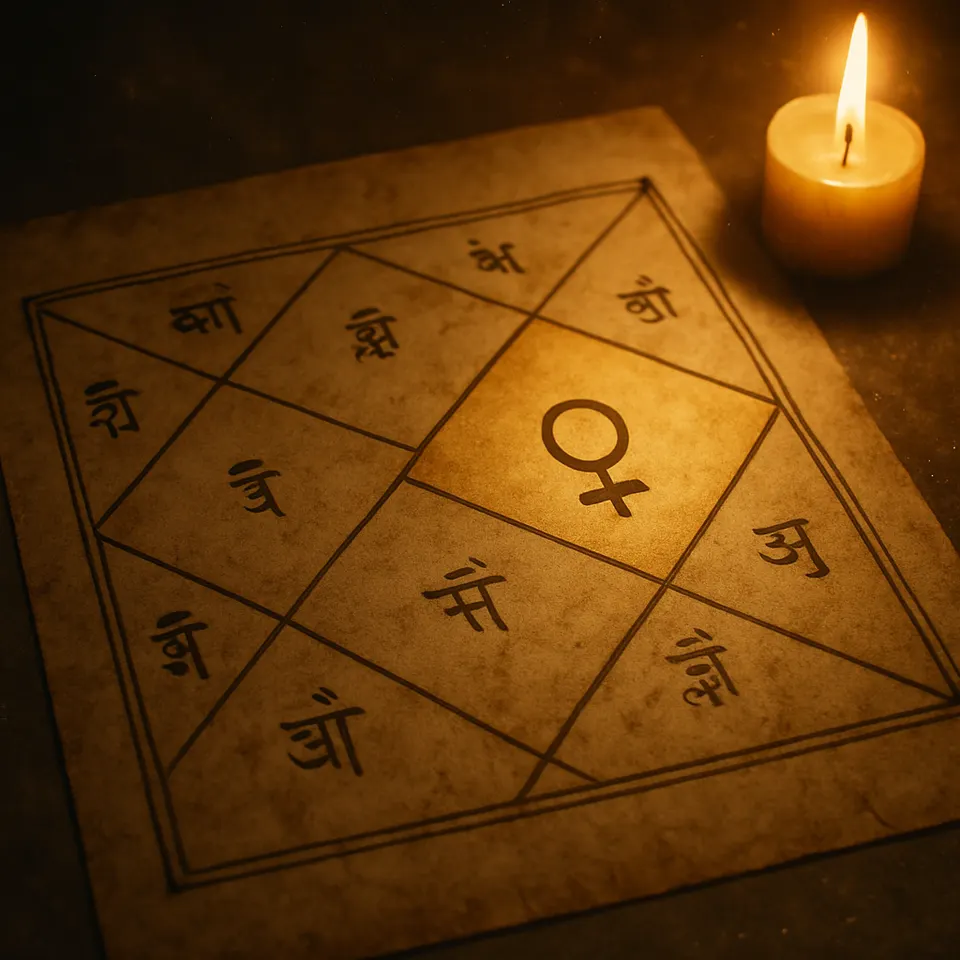
What the 7th House Actually Rules
Most people know the 7th house is about marriage. But its jurisdiction is wider than that. It governs:
- Your legal spouse or long-term committed partner
- Business partnerships and contracts (anyone you're bound to by formal agreement)
- Open enemies, as opposed to hidden ones (12th house)
- The nature of your sexual relationship within marriage (different from 8th house sexuality, which is more primal and transformative)
- How you behave in one-on-one relationships when there's a power balance
- The public's perception of you as half of a couple
- The second half of life, particularly after marriage
The 7th house is a kama house, one of the four houses tied to desire and fulfillment. It sits in the kama trikona alongside the 3rd and 11th houses. That means it's not just about duty or obligation (though marriage certainly includes those). It's about what you want. What draws you. What you hunger for in another person.
Traditional Vedic astrology treats the 7th house as the primary indicator for marriage, but you'll also want to look at Venus (the natural significator of the spouse for men in classical texts), Jupiter (the natural significator for women), and the Darakaraka (the planet with the lowest degree in your chart, which represents the spouse in Jaimini astrology). These three layers together give you a much richer picture than the 7th house alone.
The 7th House Lord and What It Tells You
The ruler of your 7th house (the planet that governs the sign on your 7th house cusp) is one of the most important planets in your entire chart. Where it sits, what condition it's in, and what aspects it receives will describe not just your partner, but the whole flavor of your partnerships.
Let's say you're a Taurus rising. That puts Scorpio on your 7th house cusp, which means Mars rules your partnerships. Mars is intense, sexual, willful, sometimes combative. You're likely to attract partners who are assertive, passionate, maybe a little controlling. If that Mars sits in your 5th house in Virgo, your spouse might come through creative pursuits, romance, or even speculation. If it's in your 10th in Aquarius, they might be connected to your career or public life, and the relationship itself might have an unconventional structure.
Now, if that Mars is debilitated (in Cancer) or afflicted by Saturn and Rahu, the partnership can become a battleground. Arguments over control. Sexual frustration. A partner who's aggressive or emotionally volatile. But if Mars is exalted in Capricorn and receiving a benefic aspect from Jupiter, you get someone driven, ambitious, and protective, someone who channels that Martian energy into building something real with you.
Here's a quick rundown of what each planet as 7th lord can bring (when well-placed):
- Sun: A spouse with authority, dignity, possibly older or more established. The relationship itself becomes central to your identity.
- Moon: An emotionally nurturing partner, someone gentle and intuitive. Marriage brings emotional security.
- Mars: Passionate, energetic, sometimes competitive. Physical chemistry is strong.
- Mercury: Intelligent, communicative, youthful. You need conversation and mental stimulation in the relationship.
- Jupiter: Wise, generous, spiritually inclined. This is one of the best placements for marital happiness (especially for women in classical interpretation).
- Venus: Romantic, artistic, affectionate. Natural ease in partnership.
- Saturn: Serious, responsible, possibly older or more mature. Marriage comes with duty, but also deep commitment.
If your 7th lord is debilitated, combust, or hemmed between malefics (papa kartari), relationships will be harder. You'll have to work for what others get easily. But that doesn't mean a bad marriage, just one that requires consciousness and effort.
Planets in the 7th House
An empty 7th house isn't a problem. It just means you look to the 7th lord for information. But if you do have planets sitting in your 7th, they color everything about partnership.
Venus in the 7th is classically one of the best placements. Venus is happy here. It brings charm, romance, and a genuine desire for partnership. Your spouse is likely attractive, artistic, and affectionate. You tend to marry someone you're genuinely attracted to, not just someone suitable. If Venus is afflicted (say, conjunct Saturn or Rahu), there can be delays, disappointments, or a partner who's emotionally distant despite being physically present.
Jupiter in the 7th expands partnership. For men, this can mean a wife who's wise, educated, spiritual. For women, it can sometimes (according to classical texts like Saravali) indicate two marriages or relationships, because Jupiter's expansiveness doesn't always sit comfortably in the house of one partner. Modern astrologers interpret this more liberally: it can mean a spouse who's a teacher, guide, or someone from a different cultural or religious background.
Saturn in the 7th delays marriage, but it stabilizes it once it happens. Your spouse is likely older, more serious, or carries responsibility. There's a karmic weight to the relationship. You're here to learn something through partnership, usually patience, commitment, or how to love someone despite flaws. Saturn here can also mean you're attracted to people who are emotionally unavailable (until you work through that pattern).
Mars in the 7th is Manglik dosha (if you're using that framework), and it brings heat to partnership. Passion, yes, but also conflict. You need a partner who can handle intensity. If Mars is well-placed (in its own sign or exalted), you get a dynamic, energetic spouse. If afflicted, you get arguments, sexual incompatibility, or someone who's controlling.
Rahu or Ketu in the 7th are tricky. Rahu brings obsession, foreign partners, unconventional relationships (age gaps, cross-cultural marriages, same-sex partnerships in traditional societies where that's taboo). Ketu brings detachment, spiritual partnerships, or someone who feels emotionally distant. Both nodes here often mean the partner is somehow "different" from what your family or culture expects.

The Spouse's Appearance and Nature
Vedic astrology gets surprisingly specific about physical traits. The sign on your 7th house cusp, the planets in your 7th, and the placement of your 7th lord all contribute.
- Fire signs (Aries, Leo, Sagittarius): Athletic build, strong features, possibly reddish or warm-toned complexion. Energetic, independent nature.
- Earth signs (Taurus, Virgo, Capricorn): Solid, grounded appearance. Practical, reliable, sometimes reserved.
- Air signs (Gemini, Libra, Aquarius): Tall or slender, expressive face. Communicative, social, intellectually curious.
- Water signs (Cancer, Scorpio, Pisces): Soft features, expressive eyes. Emotionally sensitive, intuitive, sometimes secretive.
But planets add layers. Venus gives beauty and grace regardless of sign. Saturn gives a lean or bony structure, sometimes older-looking features. Jupiter gives a fuller figure and jovial disposition. Mars gives sharp features and muscular build.
I've seen charts where a Libra 7th house (ruled by Venus, beautiful in theory) had Saturn and Ketu sitting in it, and the spouse, while dignified and serious, was ascetic-looking and emotionally distant. The sign gives the base template, but the planets modify everything.
Timing Marriage with the 7th House
When will you get married? That's the question everyone asks. The 7th house gives clues, but you need to layer multiple techniques.
Dasha periods (Vimshottari Dasha) are the most reliable timing tool. Marriage often happens during the mahadasha or antardasha of:
- Your 7th lord
- Planets sitting in your 7th house
- Venus (for men) or Jupiter (for women) in classical interpretation
- The Darakaraka (spouse indicator in Jaimini)
- Lords of the 2nd house (family) or 11th house (fulfillment of desires)
Let's say you're running Venus mahadasha and Venus rules your 7th house. That's prime marriage timing, especially if transiting Jupiter is also aspecting your 7th house or 7th lord.
Transits matter too. Jupiter's transit over your 7th house, your 7th lord, or your ascendant often triggers marriage or serious relationships. Saturn's transit can delay or solidify, depending on the rest of the chart.
Divisional charts add precision. Check your Navamsa (D9 chart), which is the marriage chart. If your 7th house in the main chart looks difficult but your Navamsa 7th is strong, marriage improves with time. If it's the reverse, early romance fades into difficulty.
One example: I knew someone with Saturn in the 7th in their birth chart (late marriage, serious partner) but Venus exalted in the Navamsa 7th. She married at 34 (late by cultural standards), but the marriage itself was deeply loving and stable. The birth chart showed the timing; the Navamsa showed the quality.
Afflictions and Remedies
What if your 7th house is a mess? Saturn and Mars conjunct in Scorpio in the 7th. Rahu sitting there with no benefic aspects. 7th lord debilitated in the 6th or 8th house. Does that mean you're doomed?
No. It means you'll face specific challenges, and you'll grow through them. Afflicted 7th houses often produce late marriages, difficult partners, or relationships that teach hard lessons. But they can also produce deeply conscious partnerships if you're willing to do the inner work.
Practical remedies (if you're into that):
- Strengthen Venus (the natural karaka for partnership) through Friday fasts, wearing white or pastel colors, or donating to women's causes.
- Chant the Shukra mantra (Om Shum Shukraya Namaha) on Fridays, 108 times for 40 days.
- If your 7th lord is weak, strengthen that planet through its specific remedies.
- Worship deities associated with partnership: Parvati and Shiva, Lakshmi and Vishnu.
Psychological remedies (which I find more effective):
- If your 7th house shows partners who are controlling, ask yourself where you've given away your power. Saturn in the 7th often means you're attracted to authority figures because you don't own your own.
- If you keep attracting emotionally unavailable people (Ketu in the 7th, 7th lord in the 12th), investigate your own patterns of detachment or fear of intimacy.
- If marriage keeps getting delayed (Saturn aspecting the 7th, 7th lord debilitated), work on self-partnership first. You won't attract a healthy partner until you're whole on your own.
The chart shows the pattern. Your consciousness decides whether you repeat it or transform it.

The 7th House Beyond Marriage
Partnerships aren't just romantic. The 7th house governs any relationship where there's formal commitment and mutual obligation.
Business partnerships fall here. If you're going into business with someone, check synastry (how your charts interact), but also look at your own 7th house. A strong 7th house and 7th lord make partnerships profitable. An afflicted 7th can mean disputes, lawsuits, or partners who cheat you.
Open enemies are also 7th house territory. These are people who oppose you publicly (versus 12th house enemies who work behind your back). If your 7th house is heavily afflicted, you might face public disputes, lawsuits, or relationships that turn adversarial.
The public's perception of you as a partner lives here too. A well-placed Venus in the 7th can make you seem like an ideal spouse or business partner. Mars or Rahu can make you seem difficult, demanding, or unconventional.
Some astrologers also look at the 7th house for the nature of your sexual relationship within marriage (as opposed to 8th house sexuality, which is more about raw desire, transformation, and taboo). A 7th house with Venus and Moon suggests tender, affectionate lovemaking. A 7th house with Mars and Rahu? Probably more intense and experimental.
Working With Your 7th House
Here's what I tell clients: your 7th house describes the kind of partner you're likely to attract and the lessons you'll learn through partnership. But attraction isn't destiny. You can be drawn to emotionally unavailable people your whole life (7th lord in the 12th, Ketu in the 7th) and still choose not to marry one. Awareness is half the work.
If your 7th house suggests a partner who's serious and older (Saturn), don't fight it by chasing the life-of-the-party type. You'll end up frustrated. Embrace what you actually need: stability, commitment, someone who takes you seriously.
If your 7th house shows delayed marriage (Saturn aspecting, 7th lord in the 8th), use that time. Build yourself. Become the person a great partner would want to be with. I've seen too many people with late-marriage charts rush into partnerships out of panic, only to divorce and marry again later (during the actual astrologically indicated timing).
And if your 7th house shows real difficulty (multiple malefics, debilitated 7th lord, harsh aspects), consider that partnership might not be your primary path for growth in this life. Some people are here to learn through solitude, creativity, or service, not marriage. That's not failure. It's just a different curriculum.
The Vedic tradition is clear: marriage is one of the four life goals (purusharthas), specifically kama (desire) and dharma (duty). But it's not the only one. Artha (wealth, security) and moksha (liberation) matter too. Your chart will show you which path is most emphasized for you.
Your Next Step
The 7th house is just one piece of the puzzle, but it's a big one. If you're curious about what your specific 7th house reveals (the sign, the lord, the planets, the aspects, the dashas), the easiest way to get clarity is to see your full chart interpreted by someone who knows what they're looking at.
You can get a free, personalized astrological reading on AstroClick that'll walk you through your 7th house, your Darakaraka, your Venus and Jupiter placements, and the timing periods when partnership is most likely. It takes about two minutes to generate, and it's based on your exact birth data, not sun-sign generalities. Think of it as a detailed map for one of the most important areas of your life. You can grab yours here and see what your chart has been trying to tell you all along.